


Most hotel software is easy to place. A channel manager talks to the agencies, a booking engine takes direct bookings, a revenue tool suggests prices. The property management system is the one everything else depends on, and the one most often confused with the software sitting next to it.
This page covers what a PMS actually does, day by day, how it differs from a channel manager and a booking engine, cloud against on-premise, what changes when you run more than one property, and what to ask before you commit.
What a hotel property management system is
Ask ten hoteliers what a PMS is and you get ten answers, each shaped by whichever product they bought. The definition that survives every property type is narrow. A PMS is the system of record for the stay. If a piece of information belongs to a guest who is arriving, staying or has stayed, it lives there, and if two systems disagree about whether room 204 is free tonight, the PMS decides.
What PMS stands for
You will also see hotel management software, front desk system and hotel operating system used for the same thing. Those are marketing names rather than categories. The older front office system is narrower and covers reception only, which is where PMS products started before they absorbed housekeeping, billing and reporting.
What a PMS is not
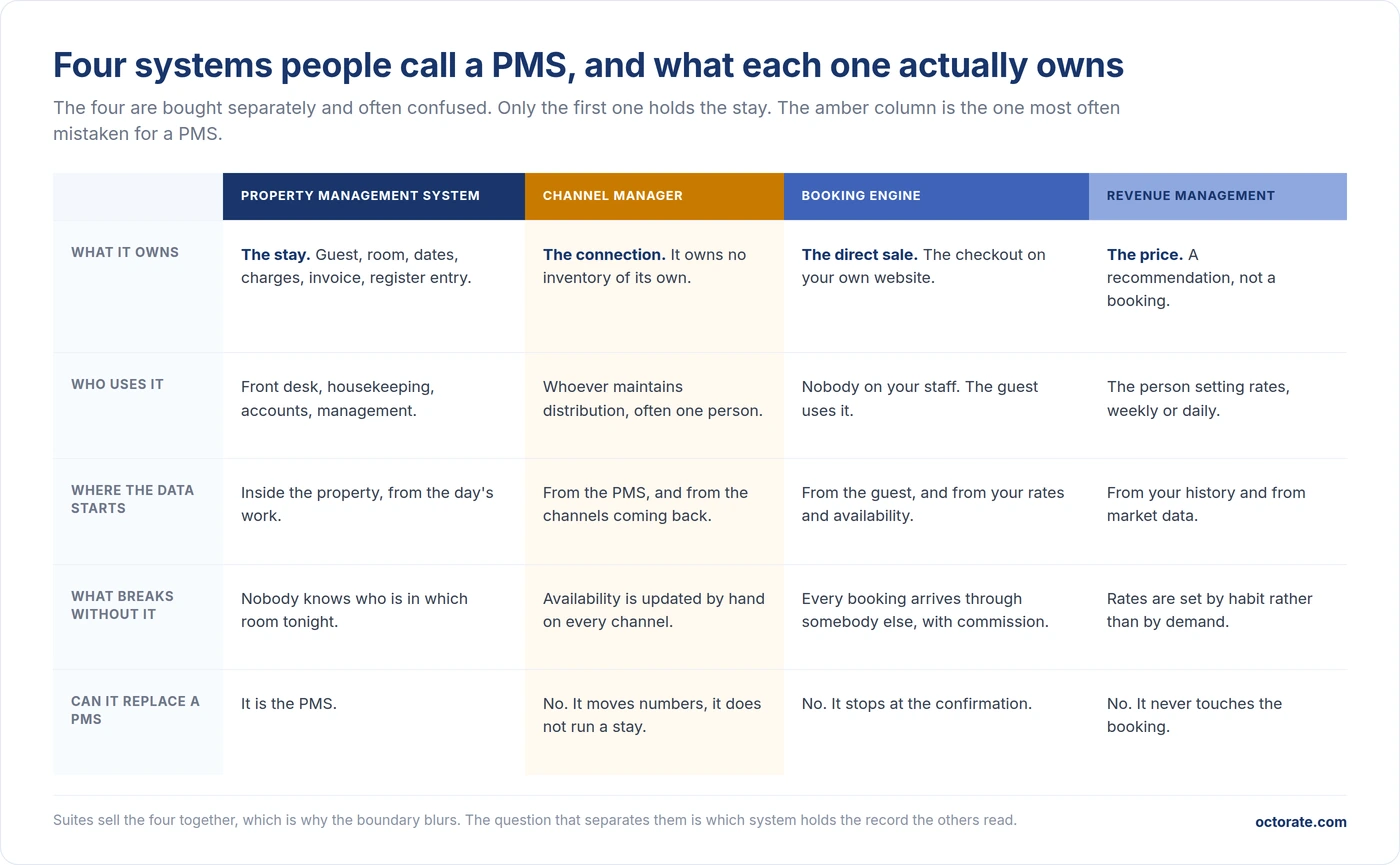
Three products are routinely confused with a PMS, and the confusion is expensive because a property can pay for one while believing it has bought another. A channel manager moves numbers between your system and the online travel agencies, holding no inventory of its own. A booking engine is the checkout on your own website and stops at the confirmation. A revenue management system recommends a price and never touches a booking.
None of the three can tell you who is sleeping in room 204 tonight. That is the test.
What a hotel PMS actually does
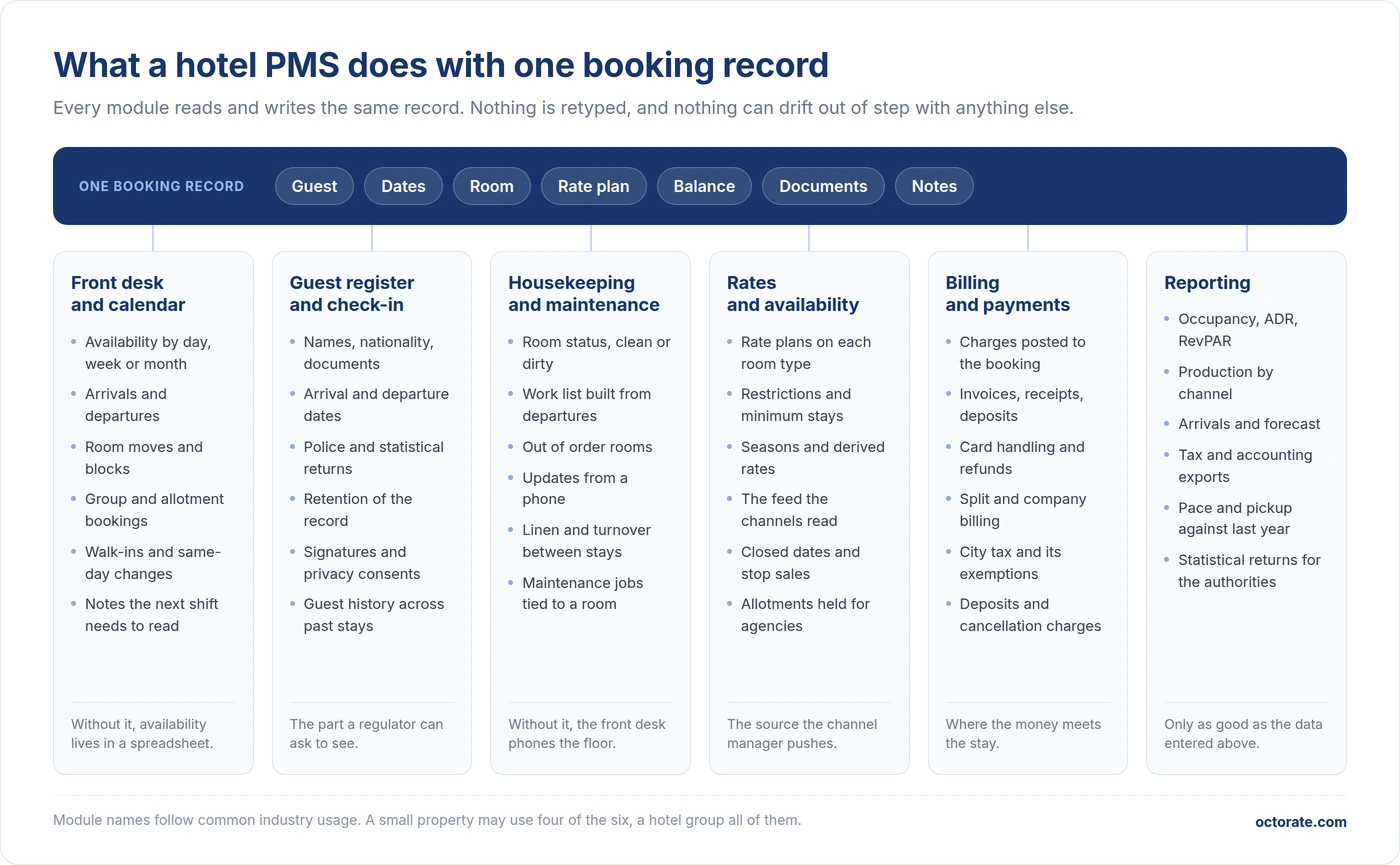
Feature lists are long and interchangeable. It is more useful to watch what a PMS does to one booking record, because every module is a different way of reading or writing it.
The calendar and the booking record
A booking on it carries the guest, the dates, the room type, the rate plan, the channel, the balance and whatever notes the last shift left. Room type and individual room are not the same thing. Most bookings arrive against a room type, and allocating room 204 is a separate decision usually taken the day before arrival.
The guest register and check-in
Check-in is the moment the booking becomes a stay. The guest is identified, the details recorded, a room allocated, a deposit taken, and the room status changes. Properties running self check-in collect the same data before arrival, which moves when the work happens rather than whether it happens.
Under the Immigration (Hotel Records) Order 1972, every guest aged 16 or over must give their full name and nationality on arrival. Guests who are not British or Commonwealth nationals must also give the number and place of issue of their passport or identity document, and, on or before departure, their next destination. The keeper of the premises must hold those records for at least 12 months, open to inspection by a constable. Italy, Spain, Portugal and several other countries have their own filing rules, usually with the police or a statistical authority, which is why a PMS built for a market produces the export directly. On the other side, the Information Commissioner’s Office is explicit that UK GDPR sets no fixed retention period, so a property needs a written rule and a system that erases or anonymises what it no longer needs.
Housekeeping
It belongs in the PMS because of timing. The front desk needs to know which rooms are ready before checking anybody in early, and the floor needs to know which rooms are leaving. On separate systems that gap is filled by phone calls, and a shared housekeeping checklist updated from a phone removes most of them.
Rates and availability
A rate plan is not a room. The room type is physical and you own a fixed number of them. The rate plan is a commercial condition attached to selling it, such as flexible, non-refundable or breakfast included. One room type carries several rate plans drawing on the same pool, and the commonest setup error in small properties is creating a separate room type for each rate, which splits the inventory in two.
Restrictions live here too. Minimum and maximum stay, closed to arrival, closed to departure, stop sale. They shape demand without touching the headline price, and only work when set in one place and pushed everywhere.
Billing, invoicing and payments
This part varies more by country than any other. Invoice numbering, tax categories, receipts and electronic invoicing formats are national, and a system that handles them for your market saves an hour a day. Card handling, pre-authorisations and refunds sit alongside, usually in a payment module rather than in the PMS core.
Reporting
Reports are only as good as what was entered upstream. A property that does not record which channel a booking came from cannot see which channel is worth its commission, and no reporting module invents the answer.
The gain from a PMS is not a feature. It is that the same fact is stored once. The room is free or it is not, the guest has paid or has not, the room is clean or is not, and exactly one place knows.
Properties running two or three disconnected tools spend their time reconciling rather than operating, and that cost is invisible in the accounts because it is paid in hours.
How a hotel PMS works through the day
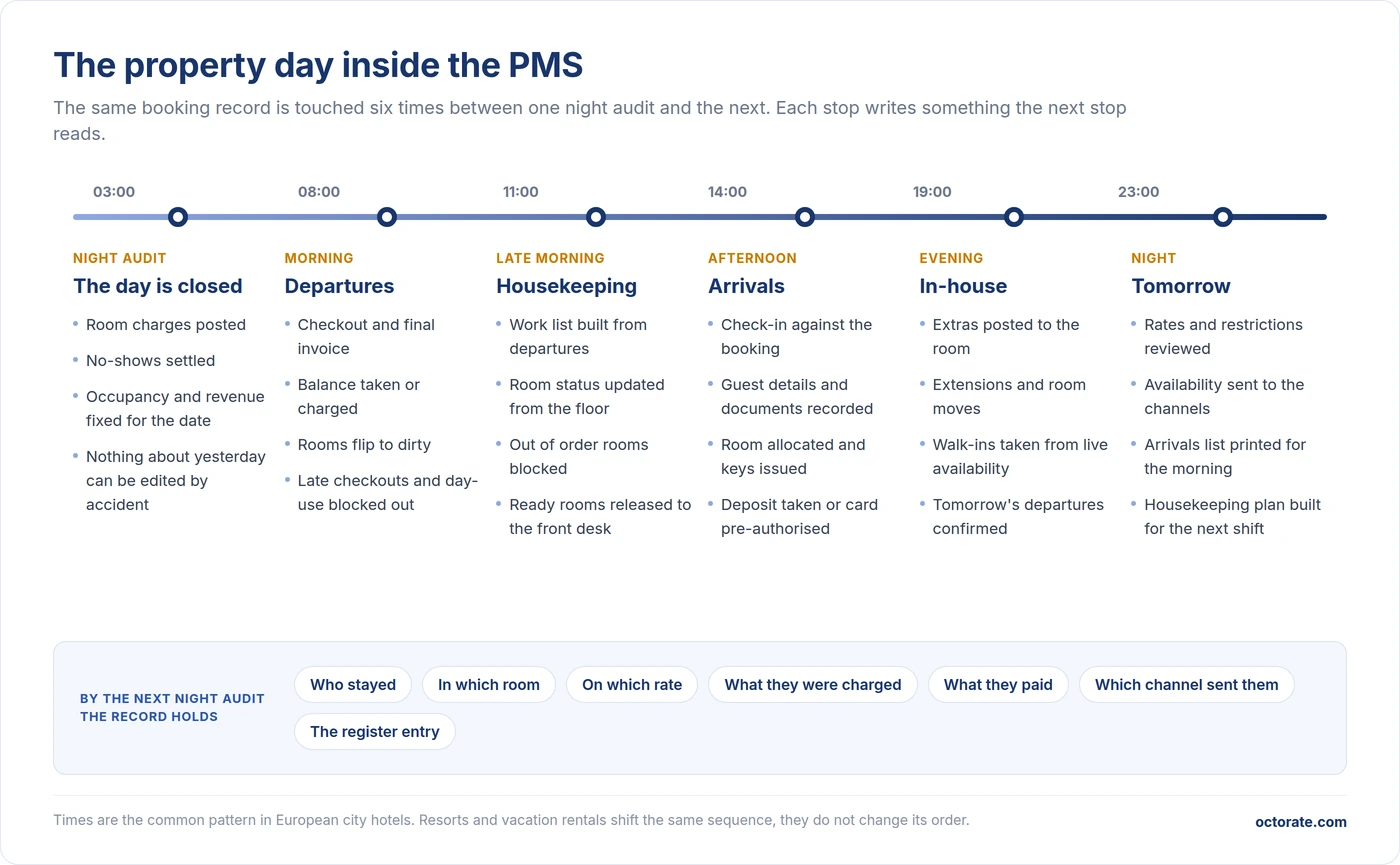
The clearest way to see how a PMS works is to follow one property day from one night audit to the next. Each stage writes something the next reads, which is why skipping one surfaces two stages later.
The night audit
It is the least glamorous part of a PMS and the one that makes the reporting trustworthy. Without a hard close, yesterday keeps changing every time somebody corrects something, and no two reports run a week apart agree. Modern systems run it automatically at a set hour, so nobody has to be awake at three. What still needs a human is the exception list it produces.
Cloud PMS and on-premise PMS
This is the second most searched question about property management systems, after what one is, and the answer has tilted over the last decade without becoming automatic.
What a cloud PMS is
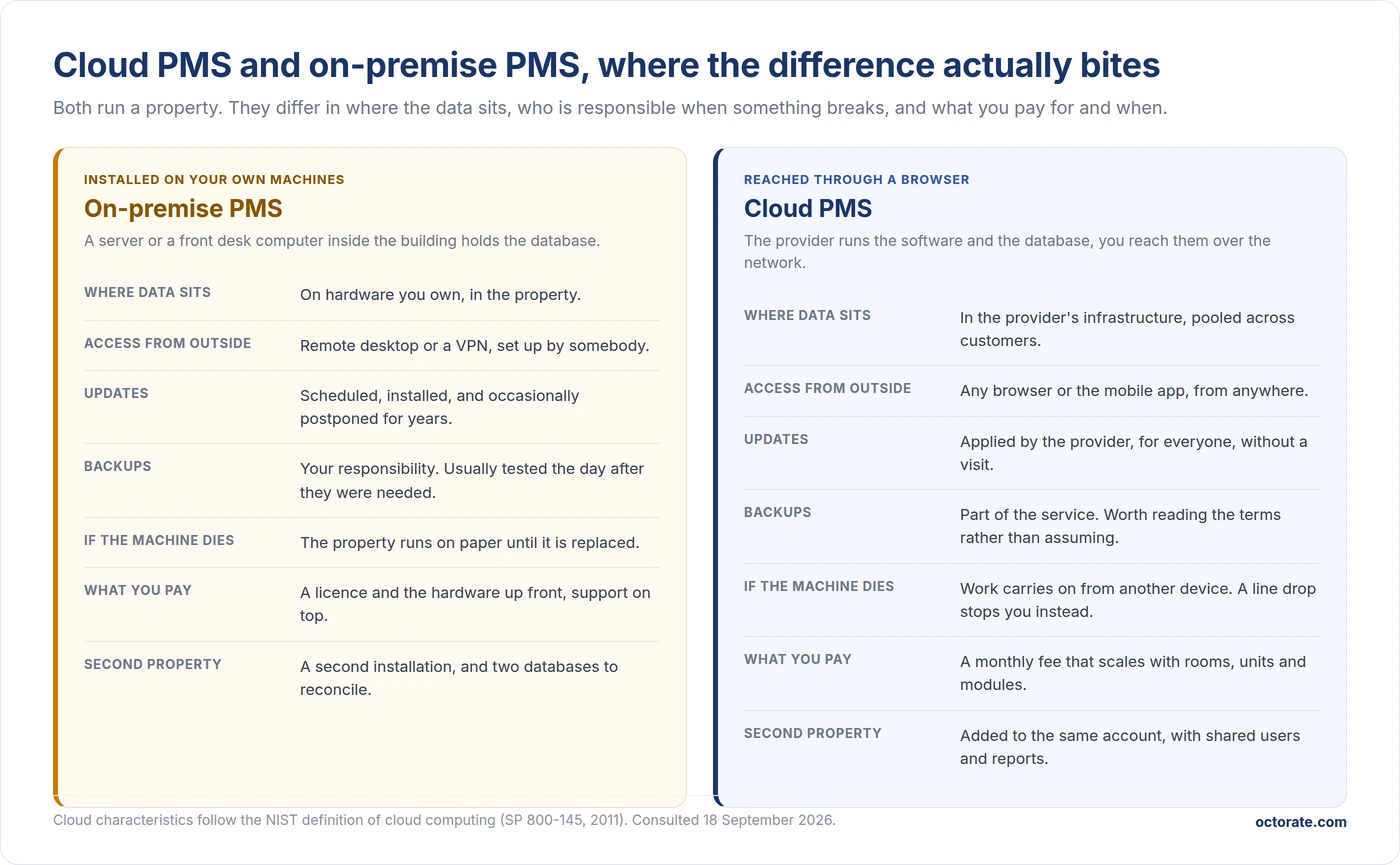
The underlying model is what the United States National Institute of Standards and Technology calls software as a service. NIST attaches five characteristics to cloud computing, namely on-demand self-service, broad network access, resource pooling, rapid elasticity and measured service. A PMS sold as cloud should satisfy all five rather than simply being reachable over the internet.
What an on-premise PMS is
On-premise is not obsolete. Large properties with heavy local integrations, poor connectivity or data residency obligations still run it deliberately. What changed is that it now needs justifying rather than being the default.
Which one fits your property
The decision is rarely about features, because feature lists converge. It is about who holds the risk.
| If this describes you | The one that usually fits | Why |
|---|---|---|
| Under 50 rooms, no IT staff | Cloud | Nobody on site has to own backups, updates or a failing machine. |
| More than one property or unit | Cloud | One account, shared guest data and users, consolidated reporting. |
| Owner or manager works off site | Cloud | Access from a browser or a phone without a VPN. |
| Connectivity is genuinely unreliable | Depends | Ask what the system does offline, and test it before signing. |
| Data must stay on your own hardware | On-premise | A policy or contract requirement, not a technical preference. |
The connectivity row is the one worth testing rather than assuming. Ask what happens to check-in when the line drops for an hour.
The PMS and the channels you sell on
A large share of the people searching for a property management system are really asking how their rooms end up on Booking.com, Airbnb and Expedia at the right price. Three systems are involved, and knowing which does what saves buying the wrong one.
Is Booking PMS a product
Searches for booking pms mean one of two things. How to connect a PMS to Booking.com, or how to stop maintaining availability by hand in the extranet. The arrangement below answers both.
One inventory, many channels
The rule that prevents most distribution problems is short. One pool of rooms, in one system, read by every channel.
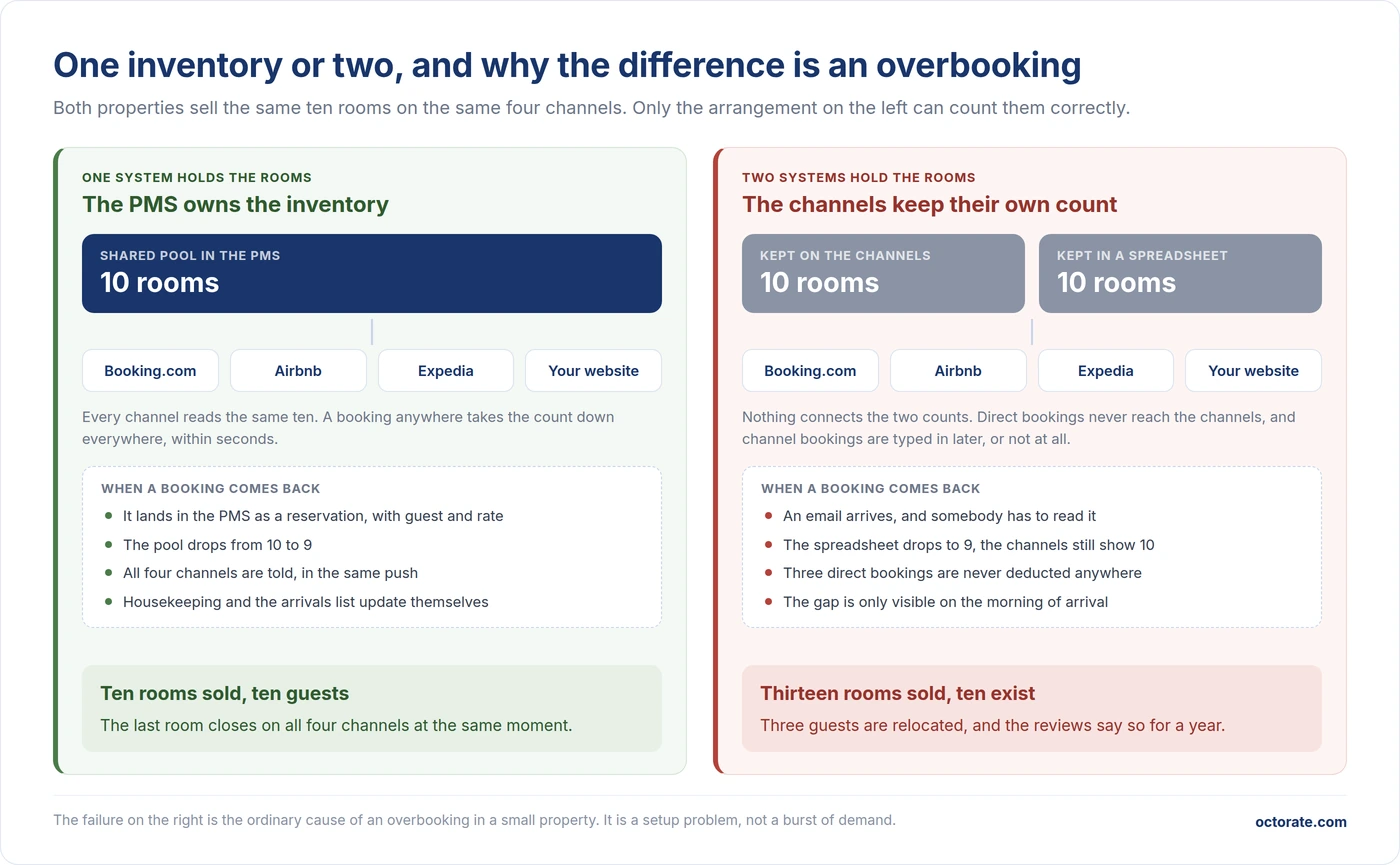
When availability is held in the PMS and pushed out by a channel manager, a booking on any channel reduces the same pool and that reaches every other channel within seconds. When the channels keep their own counts and somebody retypes bookings into a spreadsheet, the counts drift silently until the morning three guests arrive for one room. That is what an overbooking usually is in a small property. Not a burst of demand, a setup problem.
Mapping, and where it goes wrong
Two failure modes are worth knowing. A room sold under two types with separate availability, so ten twin and double rooms are listed as ten twins and ten doubles and both sell out. And a mapping pointing at the wrong counterpart, so the numbers move to the wrong room. Both stay invisible until a guest is at the desk. The same connection carries your rooms to metasearch, where guests compare your direct price with the agencies’.
Direct bookings, and why they change the maths
Every booking through an agency carries a commission, and every booking through your own booking engine does not. Operationally the point is that a direct booking has to reduce the same pool as an agency booking, instantly. A booking engine writing into the PMS does that. A booking form that emails you does not, and it will eventually cost you a room you had already sold.
One property or several
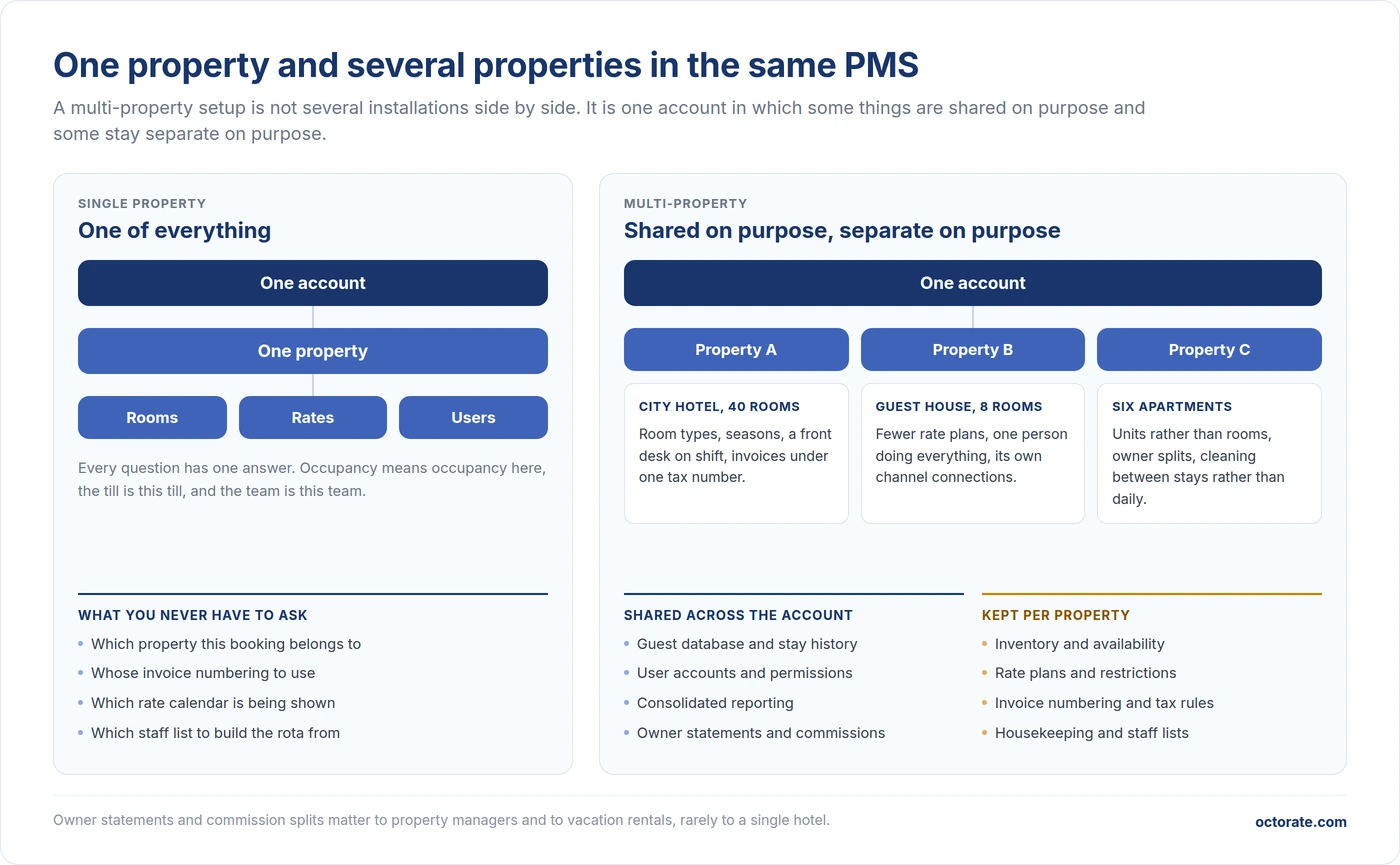
A multi-property setup is not several installations standing side by side. It is one account in which some things are deliberately shared and some deliberately kept apart, and putting that line in the right place is most of the work.
Hotels, guest houses and vacation rentals
A hotel is the case every PMS is built for. Rooms, a front desk on shift, housekeeping, group bookings and a rooming list to load when a coach arrives. What separates one product from another here is group handling, split billing and the night audit.
A guest house has the same obligations and a fraction of the staff. One person is the front desk, the housekeeper and the accountant, so the measure of a good PMS is how few steps a booking takes from arriving to being invoiced.
Vacation rentals count units rather than rooms, clean between stays rather than daily, and add requirements a hotel never has. Owners who need statements, commission splits and sight of their own calendar without seeing anybody else’s. That is why the owner portal exists as a separate module.
| Property type | What the calendar counts | Cleaning | The requirement others do not have |
|---|---|---|---|
| Hotel | Rooms by type, sold by the night | Daily, plus turnover | Group bookings, split billing, night audit |
| Guest house or B&B | A small number of rooms | Turnover, often by the owner | One person doing every role, so fewer steps per booking |
| Vacation rentals | Whole units, minimum stays | Between stays, scheduled around arrivals | Access and key handover without a front desk |
| Property manager | Units across several owners | Coordinated across addresses | Owner statements and commission splits |
The right-hand column is the one that decides. A product that handles it is worth more than one with a longer feature list.
How to choose a hotel PMS
Every vendor demo shows the same twenty minutes. The calendar, a booking being made, a colourful dashboard. The differences that matter sit in the parts nobody demonstrates.
- Your market’s paperwork. Invoicing rules, tax categories, police and statistical returns for your country. The biggest source of daily friction, and the hardest to work around.
- The connections you need. The channels you sell on, your payment provider, your door locks, your accountant’s software.
- How a mistake gets fixed. Moving a booking, splitting a folio, correcting an invoice, cancelling after a deposit. Ask to see all four.
- What happens on a phone. Housekeeping and small property owners work from a phone, not a desk.
- Who answers when it breaks. Hours, language, and whether a human answers on a Sunday in August.
- How you would leave. Export of bookings, guests and invoices, readable, without a fee.
Questions worth asking before you sign
| Ask this | Why it matters | A poor answer sounds like |
|---|---|---|
| Show me a wrong booking being corrected | The commonest front desk action after check-in. | Support can do that for you. |
| How does my data leave if I go | Migration cost is the real lock-in, not the contract. | Nobody leaves. |
| Which of my channels are already connected | A connection that does not exist yet is a roadmap item. | We can build it. |
| What is not in this price | Modules, extra properties, users and support tiers often are not. | Everything is included. |
| What happens when the connection drops | A cloud system’s worst day is the one you should ask about. | That does not happen. |
Five questions that take ten minutes and separate products that look identical in a demo.
Moving from what you have now
Migration is underestimated, and it is why properties stay on software they dislike for years. What has to move is smaller than it feels. Current and future bookings, the guest database, room types and rate plans, and the open invoices. History is usually archived rather than imported.
The sensible window is a low occupancy week, both systems running for a few days, one person reconciling. The dangerous version is a migration in high season, decided in a hurry.
Write down the five things that take most of your time in an average week, and the three pieces of paperwork your country requires. Take that list into every demo and make the vendor show you those eight things. It turns a feature tour into a comparison, and exposes products that are strong everywhere except in your market.
What a hotel PMS costs
There is no standard price, and a figure quoted without the shape of the property behind it is decoration. What can be described is how the pricing is built.
Cloud systems are sold as a monthly fee, and the variables are almost always the same. Rooms or units, properties, modules switched on, channels connected, users, and the support and onboarding included. Two properties with the same room count can pay very differently, because one runs payments, a website and revenue tools through the same provider and the other runs only distribution.
On-premise is a licence plus hardware, with maintenance on top. That cost lands earlier and is easier to underestimate, because the server, the backups and the person who looks after both are rarely in the quoted figure. Check two things in any quote. What is excluded, and what the price does with a second property.
How Octorate prices it
Octorate publishes a modular model with three plans. PMS Cloud sits in the Pro plan, alongside Channel Manager, Booking Engine, Web Concierge AI and Metasearch, and is quoted on request because the configuration depends on rooms, units, properties and the modules switched on. Ultimate adds Website Builder, WhatsApp Business and business intelligence. The breakdown is on the pricing page, and every plan starts with a 14 day free trial without a credit card.
Octorate PMS Cloud covers the calendar, invoicing and receipts, housekeeping, self check-in, reporting and a mobile app for iOS and Android, and it shares data with the Channel Manager, the Booking Engine, Payment Manager and Dynamic Pricing rather than exchanging files with them.
Try a cloud PMS on your own property before deciding
Load your rooms and rates, connect the channels you already sell on, and run a normal week. No credit card, support seven days a week, and an onboarding team that helps you set up rooms, rates and users.
Frequently asked questions
A property management system is the software a property uses to run its stays. It holds the reservation, the guest, the room, the rate, the charges and the invoice in one record, and the front desk, housekeeping and accounts all work from it. If two systems disagree about whether a room is free tonight, the PMS decides which is right.
PMS stands for property management system. The word property rather than hotel is deliberate, because the same software runs a large hotel, a small guest house and a portfolio of apartments. You will also see it called hotel management software, a front desk system or, in the narrower older sense, a front office system.
Six things, all against the same booking record. It runs the calendar and the front desk, records the guest at check-in, drives housekeeping from arrivals and departures, holds rates and availability for every channel, posts charges and produces invoices, and reports occupancy and production.
The PMS holds the stay, the channel manager moves numbers. A channel manager owns no inventory of its own. It takes availability and rates from your system, pushes them to the online travel agencies and brings bookings back. Without a PMS behind it there is nothing authoritative to push.
A booking engine is the checkout on your own website, and it stops at the confirmation. The PMS takes that confirmation and runs the stay from it, through check-in, the folio and the invoice. A booking engine writing into the PMS keeps availability correct. One that only sends an email does not.
A property management system reached through a browser, with the software and the database running on the provider’s infrastructure. Nothing is installed at the front desk, updates are applied by the provider, and the account opens from a phone or a laptop anywhere. In the NIST classification it is software as a service.
Usually, for one reason. A small property has nobody whose job is backups, updates and a failing front desk machine, and cloud moves that work to the provider. On-premise still makes sense where data must stay on your own hardware, or where local integrations and connectivity make it a deliberate choice.
No. Booking.com does not sell a property management system. It provides an extranet for your listing and a connectivity API through which an approved provider can set inventory, pricing and restrictions for your rooms. The system holding your rooms is your own, and it connects through that interface.
Yes, and it is the main reason to move off a single site installation. The guest database, the user accounts and the consolidated reporting are shared across the account, while inventory, rate plans, invoice numbering and staff lists stay with each property. Check where the vendor draws that line.
It depends on the country. In the United Kingdom the Immigration (Hotel Records) Order 1972 requires the keeper of the premises to hold the records for at least 12 months and keep them available for inspection. Separately, UK GDPR sets no fixed period, so a property has to justify its own retention rule and then erase or anonymise what it no longer needs.
The obligations are the same as a hotel’s and the staff is one person, which is an argument for a PMS rather than against it. What changes is the shape. Units rather than rooms, cleaning between stays, longer bookings, and for property managers the owner statements and commission splits a hotel product does not handle.
Cloud systems are sold as a monthly fee driven by rooms or units, properties, active modules, connected channels and users, so a single figure without the property behind it means little. On-premise is a licence plus hardware, with maintenance on top. Ask what is excluded, and what the price does with a second property.
- The Immigration (Hotel Records) Order 1972, SI 1972/1689, legislation.gov.uk. Consulted 18 September 2026
- Information Commissioner’s Office, Principle (e) Storage limitation, UK GDPR guidance. Consulted 18 September 2026
- Peter Mell and Timothy Grance, The NIST Definition of Cloud Computing, NIST Special Publication 800-145, September 2011. Consulted 18 September 2026
- Booking.com Connectivity documentation, Rates and Availability API overview. Consulted 18 September 2026
- Octorate, PMS Cloud and Pricing pages. Consulted 18 September 2026