

A guest wants to arrive after midnight. Another needs directions to the car park. At a hotel, reception is busy checking people in. At a holiday rental, the manager is at another property. A hotel chatbot can answer routine questions in both settings, provided it has the right information and a clear route to the team when someone needs help.
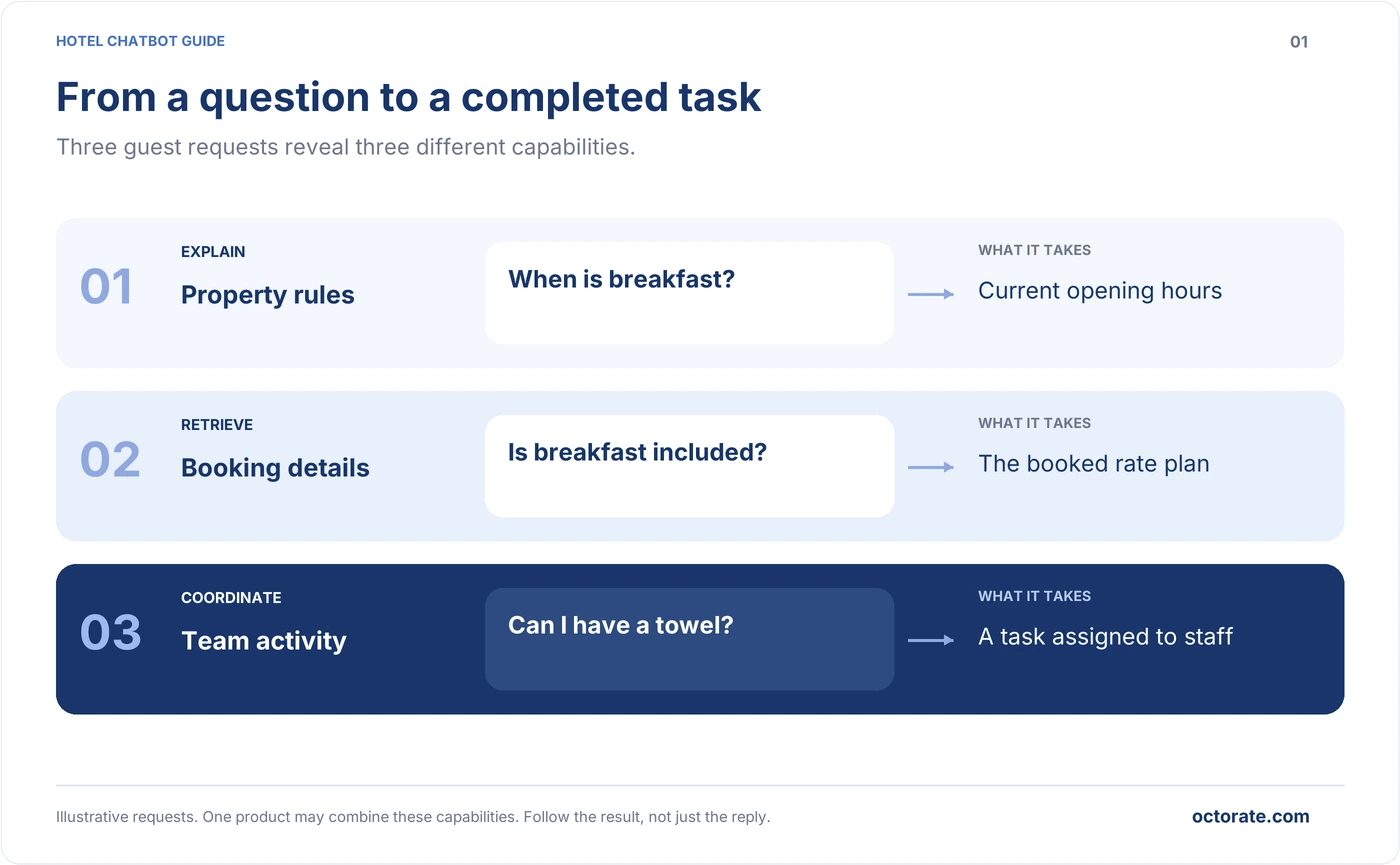
Explaining breakfast hours takes an up-to-date property rule. Confirming that breakfast is included takes information about a particular booking. Getting an extra towel delivered takes a task assigned to someone. These are three different capabilities, even when they appear in the same chat window.
What is a hotel chatbot and what can it do?
The useful question is what happens after the guest sends a message. Does the chatbot return a prepared answer, look up a booking or start an operational task? A fluent reply alone does not show which of these has happened.
Rule-based chatbots
This approach suits a small set of predictable questions. A guest selects parking, sees the entrance address and gets the access instructions. Its main limit is an unexpected request. When the conversation moves beyond the prepared options, the guest needs another route to an answer.
AI chatbots for hotels
IBM distinguishes scripted chatbots from AI chatbots by how they interpret and respond to requests. For a hotel, this matters when a guest combines several questions in one message, changes dates halfway through or asks a follow-up without repeating the original question.
AI agents and operational tasks
Product labels overlap. A system sold as a chatbot may include operational functions, while an agent may have a narrow set of permissions. During a demonstration, follow a request from the guest’s message to its recorded outcome.
| Guest question | What the system needs | Useful outcome |
|---|---|---|
| When is breakfast? | Current property information | The correct opening hours |
| Is breakfast included in my booking? | The guest’s reservation and rate plan | An answer for that specific stay |
| Can I have another towel? | A task workflow and an available team | A request assigned and followed through |
Where a chatbot helps throughout the guest journey
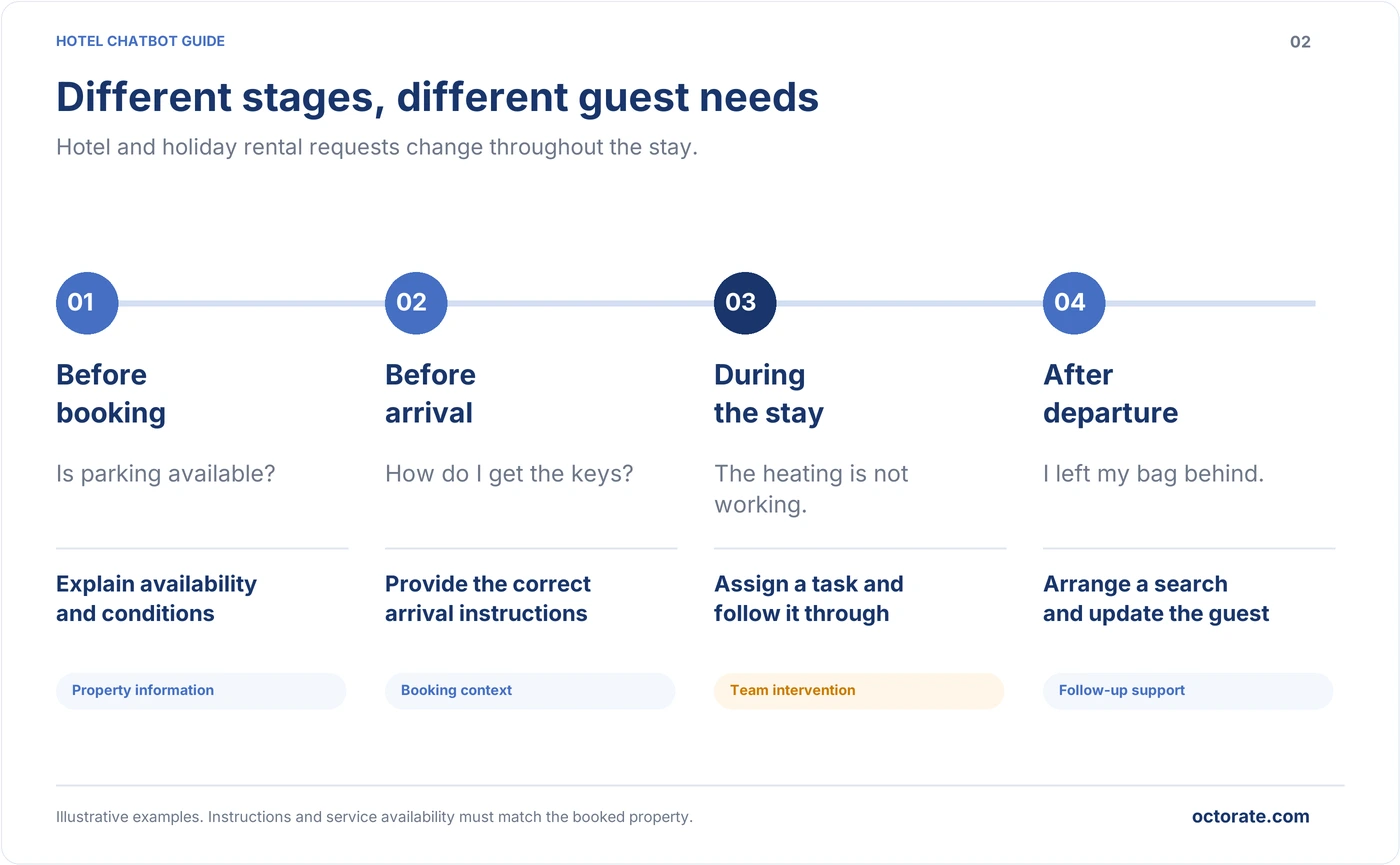
The same guest may need booking advice, directions and help with a broken appliance. Each stage calls for different information and a different measure of success.
Before booking
Questions about parking, pets, family rooms or accessibility can hold up a booking. A chatbot can explain documented facilities and conditions, then direct the guest to the relevant room or offer. Specific access questions need precise descriptions, such as steps at the entrance or lift access, rather than a vague assurance that a property is suitable.
The Booking Engine handles the booking process. If the chatbot presents availability or prices, those answers need a live source for the requested dates and occupancy. A guest following a general booking link should not be told that a room has already been reserved.
Arrival and remotely managed holiday rentals
A hotel may have one reception desk and a common breakfast policy. A portfolio of apartments may have different entrances, parking arrangements and key collection points. The address and unit attached to the booking therefore matter as much as the wording of the reply.
A chatbot can guide a guest towards Self Check-in, explain a missing step and pass an access problem to the manager. Sending directions is different from verifying identity, completing registration or issuing an access code. Those actions need their own authorised process.
For teams using Vacation Rental software, organising information by property prevents a common mistake. A correct answer for one apartment can be completely wrong for another.
During and after the stay
Requests for towels, repairs or late checkout should reach the relevant team with the room or unit, the problem and any agreed timing. A chatbot can collect this context, but acknowledging the message must not automatically mark the task as complete.
Service questions also create opportunities to explain breakfast, transfers or other available extras. An offer should match the guest’s dates and the actual service capacity. After departure, a lost item enquiry still needs someone to search the property and report back.
How an AI hotel chatbot produces an answer
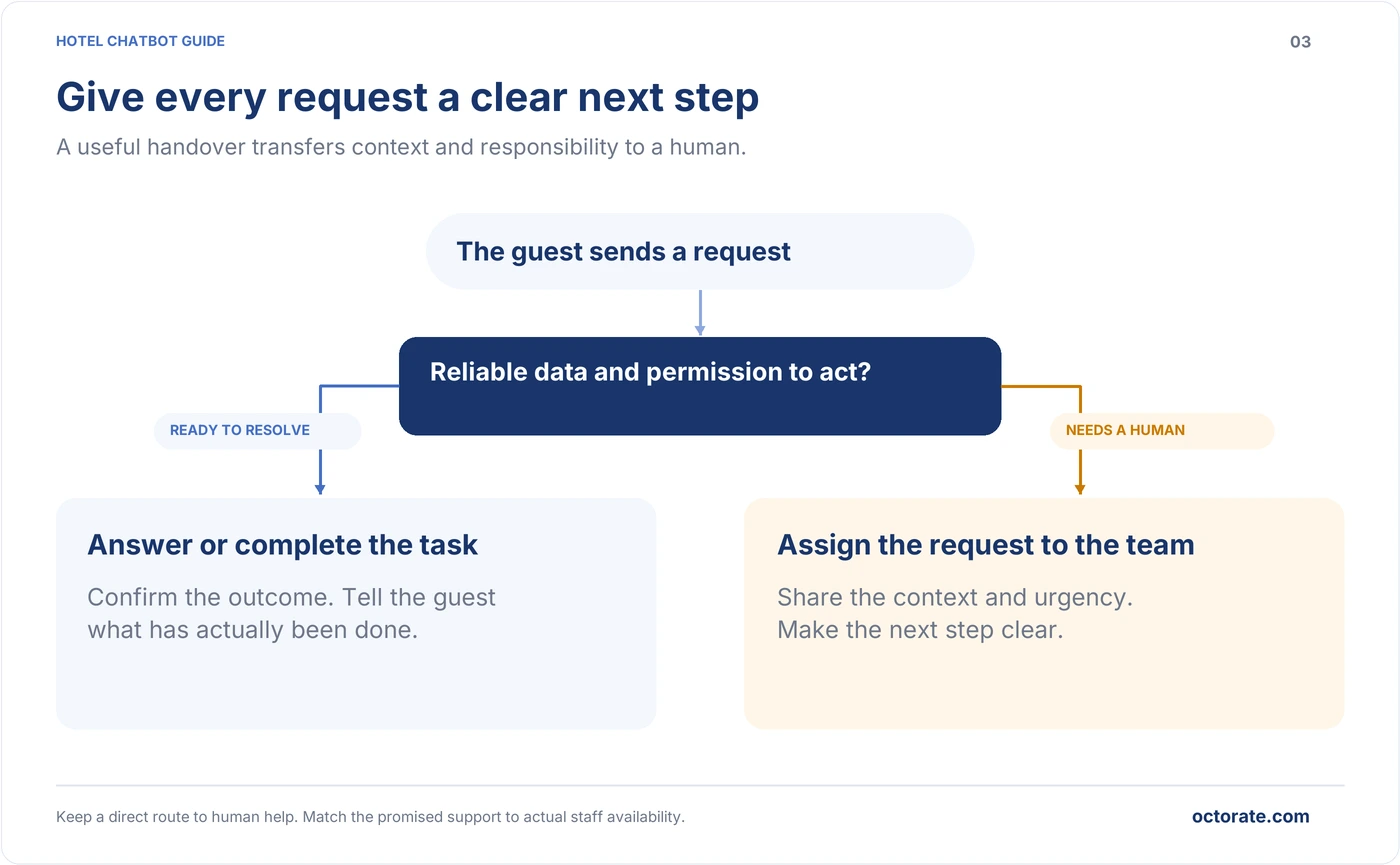
A practical workflow has three parts. The system identifies what the guest needs, retrieves relevant information and either replies or starts an authorised action. When information is missing, it needs a reliable way to ask for clarification or involve a human.
The property knowledge base
Start with the questions reception or the property manager answers repeatedly. Include the details that change the answer. Parking might be available but require a reservation. Pets might be welcome only in certain units. A pool may have seasonal opening dates.
Assign someone to maintain each topic. When a service closes temporarily, update the chatbot’s source as part of the same task as updating guest information. A well-written answer based on last season’s rules is still wrong.
A Web Concierge can provide structured guest information alongside the conversation. The useful relationship is consistent information across both, so that a chat reply and the arrival guide do not give different instructions.
Conversation context and human handover
A guest who reports a locked door should not have to repeat the address, booking reference and failed attempts after asking for help. The handover also needs an owner. A notification to an unattended inbox does not create an out-of-hours service.
Set escalation rules for urgent access problems, complaints, payment disputes and requests outside the system’s permissions. Give the guest a clear way to request a human directly, and state the actual hours of that support.
What PMS integration changes
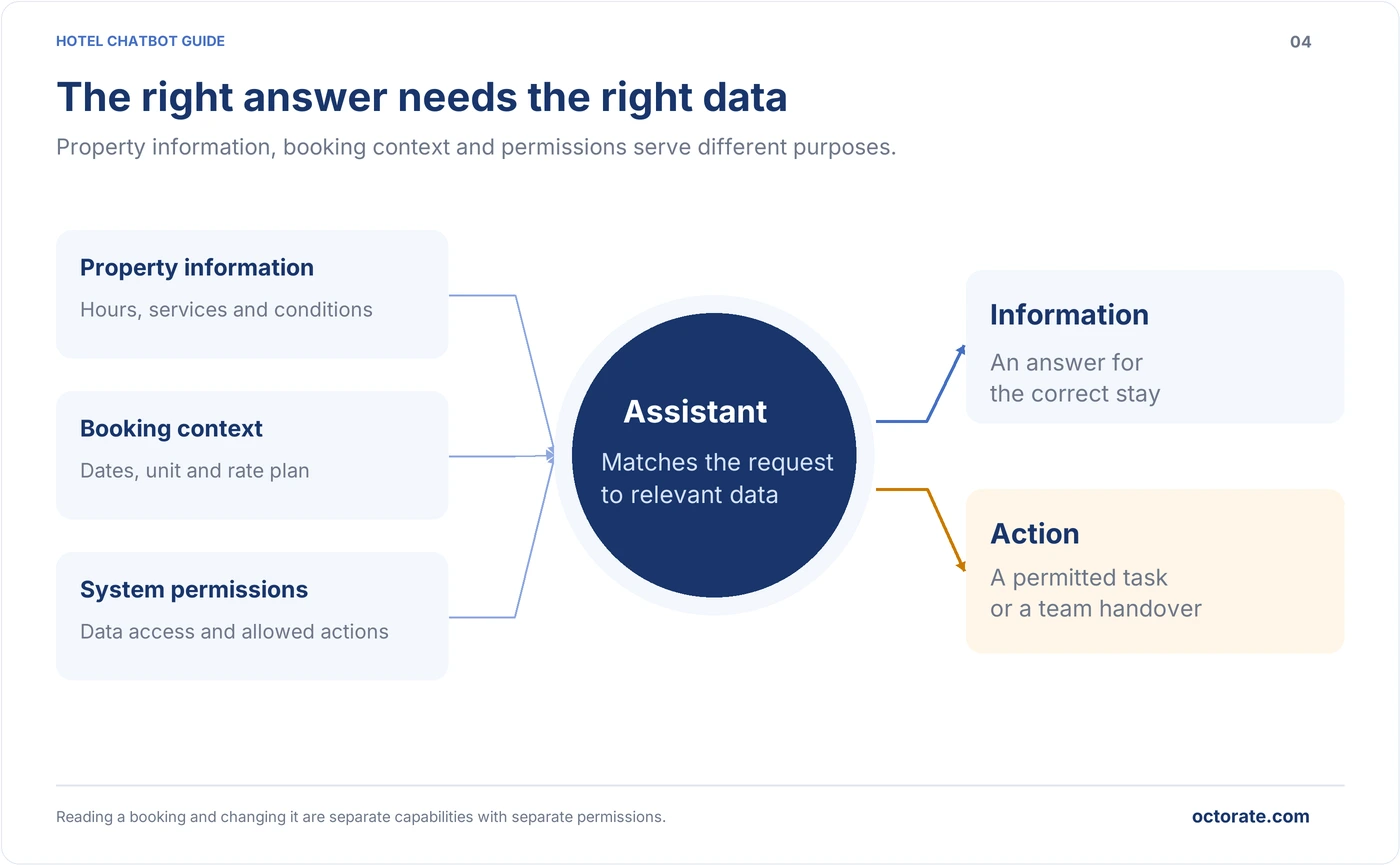
A chatbot can answer general questions without a reservation system. It needs connected booking data to reliably answer questions about a particular stay. The PMS is one source of that operational information.
Reading a booking and changing it
For a breakfast question, the relevant data might be the rate plan and included services. For an arrival question, it might be the booked unit, dates and check-in status. The system also needs an appropriate way to associate the conversation with the correct guest.
A request to change a departure date introduces another step. The system must establish whether it can perform the change, obtain any required approval and confirm the result from the booking system. A reply saying that a change has been requested is different from confirmation that it has been completed.
Where a custom connection is needed, AI Integration is a separate technical topic. The practical questions remain which data can be read, which actions are allowed and how completed operations are recorded.
Missing data and multiple properties
Useful demonstrations include incomplete information. Try a cancelled reservation, two guests with similar names or a stay moved to another apartment. The system should resolve ambiguity before disclosing booking details or carrying out a sensitive action.
Property rules also need scope. A late checkout policy at one hotel should not be applied to every property in the account. If the integration is unavailable, the assistant should explain what it can still answer and pass on requests that require live data.
These cases reveal more than a polished exchange about breakfast hours. They show whether the integration supports daily operations when the underlying information is messy.
Website, WhatsApp, email and voice channels
Choose channels around where requests arrive and who handles them. Adding another contact point is useful only if its conversations reach the same operational process.
Website chat and guest messaging
Website chat often starts before a booking exists. WhatsApp, email and OTA messages may concern an existing stay. The information available in each channel can differ, so the system needs to establish the context before offering a booking-specific answer.
A Unified Inbox gives the team a place to work on guest conversations. An inbox with suggested replies and an assistant that sends replies automatically are different operating choices. Decide which requests can be handled independently and which need review.
Managers working between apartments also need a practical way to pick up escalations. Access through a Mobile App can support that work, but notification coverage and responsibility still need to match the team’s actual working arrangements.
Voice agents and telephone requests
A voice agent adds speech to the workflow. A useful trial includes background noise, spelling a surname, correcting a date and asking for a human. Test the handover itself, including what happens when the intended recipient is unavailable.
Phone support also introduces call handling and, where used, recording or transcription arrangements. Establish what is stored, why it is needed and who can access it. A call summary can help staff continue a request, but the guest still needs a clear outcome rather than a promise that someone might read it later.
How to measure hotel chatbot benefits
The value of a chatbot is the work it completes and the service it improves. Message volume is useful for capacity planning, but it does not show whether guests received correct answers or staff saved time.
Response time and resolution time
An immediate acknowledgement can improve the first figure while leaving the second unchanged. Separate straightforward information requests from jobs requiring housekeeping, maintenance or management approval. Otherwise, a high volume of easy answers can hide slow handling of more consequential requests.
Record working hours alongside the measurements. An overnight enquiry answered automatically is a different case from a daytime request that waited for a staff member. Compare equivalent request types before and after the pilot.
Resolved requests, staff time and bookings
Review a sample of conversations against that definition. A guest who stops replying may have received a useful answer, abandoned the chat or called reception instead. Silence alone cannot distinguish those outcomes.
| Measure | What to record | What it reveals |
|---|---|---|
| Response and resolution time | Request, first reply and confirmed outcome timestamps | Where the guest still waits |
| Automated resolution | Completed requests, with conversation review | Work finished without human intervention |
| Team workload | Handling, correction and maintenance time | The net change in staff effort |
| Booking contribution | Tracked journeys from chat to completed booking | Associated bookings, subject to attribution limits |
Staff time saved should include the work created by the system. Maintaining information, correcting answers and following up incomplete tasks all take time. The useful comparison is total effort for the same workload.
For direct bookings, track the path from the conversation to the completed reservation where measurement allows it. Keep chat-assisted bookings separate from a claim that the chatbot caused additional revenue. Seasonality, rates and campaign changes can also affect the result.
A chatbot earns its place when it resolves routine requests accurately and gives the team useful context for the rest. Judge a pilot by completed work, remaining delays and total staff effort. A fast reply is the start of the service, not its completion.
Hotel chatbot cost and what to compare
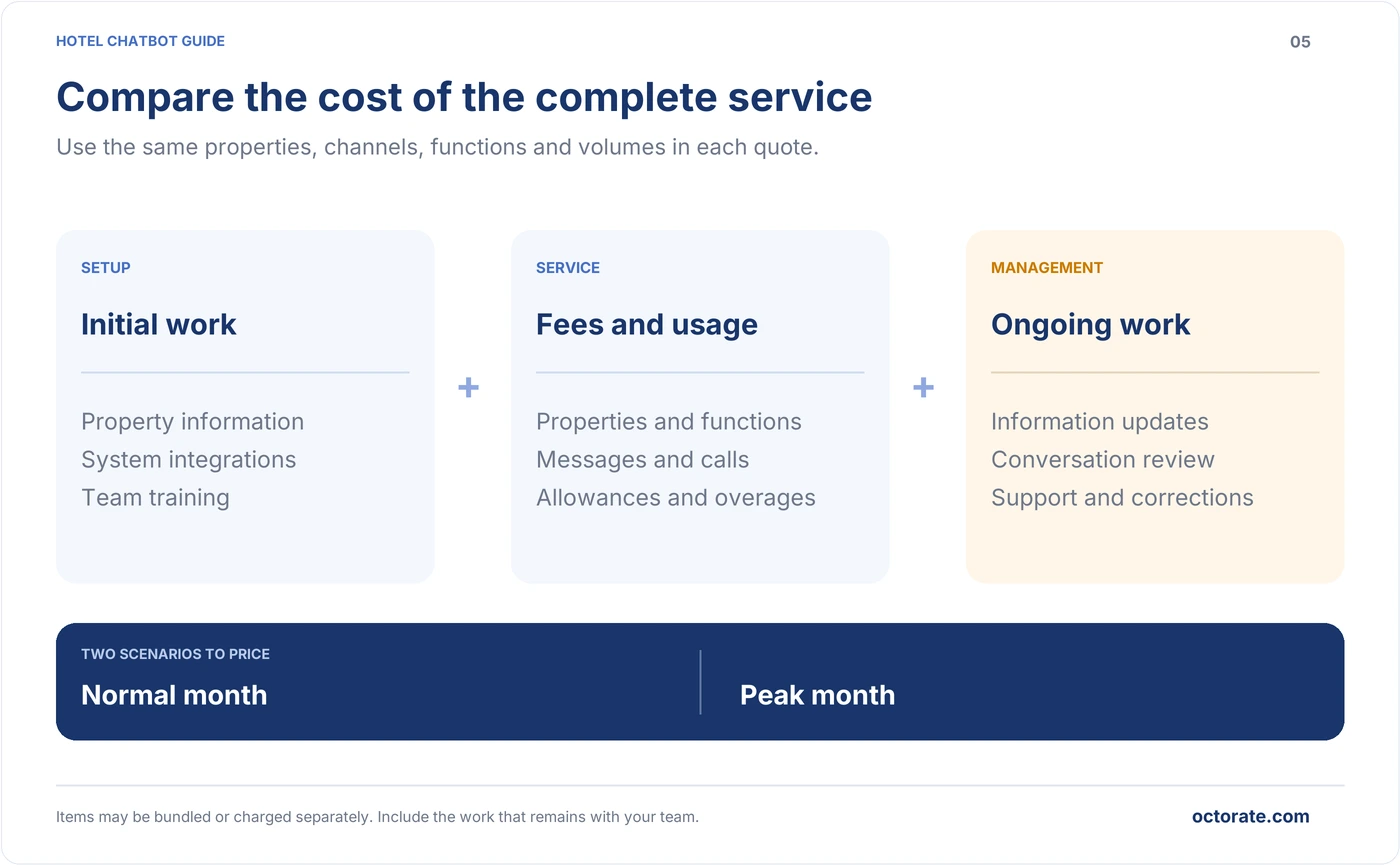
A meaningful quote describes the property, channels, request volumes and functions it covers. Two monthly subscriptions can look similar while including different integrations, usage allowances or support.
Setup, subscription and ongoing work
Use the same specification for each offer. List the number of properties, intended channels, supported languages, required PMS functions and expected message or call volumes. Include who prepares the initial information and who updates it after launch.
| Cost area | What the quote should explain | Useful comparison |
|---|---|---|
| Initial setup | Configuration, data preparation, integrations and training | One-off work included in delivery |
| Recurring service | Properties, functions, users and support | The same operating scope |
| Variable usage | Message or call allowances, unit charges and overages | A normal month and a peak month |
| Ongoing management | Updates, conversation review and incident handling | Work done by the supplier and by the property |
WhatsApp Business Platform charges
Meta’s WhatsApp Business Platform pricing applies per delivered template message in the marketing, utility and authentication categories, with rates varying by category and the recipient’s country. Free-form service replies are free within the 24-hour customer service window opened by a guest’s message and restarted by each new message from that guest; utility templates sent within this window are also free. For a chatbot handling incoming guest questions, this free service window is particularly relevant, while templates used to initiate or resume contact follow the applicable category rates and exemptions.
Keep Meta’s charges separate from the chatbot supplier’s subscription and usage fees. A message that is free at platform level can still count towards the supplier’s allowance. Base the estimate on the planned mix of incoming questions, outgoing notifications and promotional messages.
A demonstration built around your requests
Bring anonymised examples from reception or property management. Include a straightforward question, an ambiguous booking, a service that is unavailable and a request that needs human approval. Follow the resulting record in the connected system.
- Information sources. Where each answer comes from and who maintains it.
- Integration scope. The data the chatbot reads and the actions it can perform.
- Handover. Who receives unresolved requests and what the guest is told.
- Commercial scope. A written total for normal and peak usage.
A small property with few repetitive questions may first benefit from clearer arrival instructions and saved replies. A chatbot becomes more useful when there is enough recurring work to automate and enough reliable information to support the answers.
How to set up a hotel chatbot
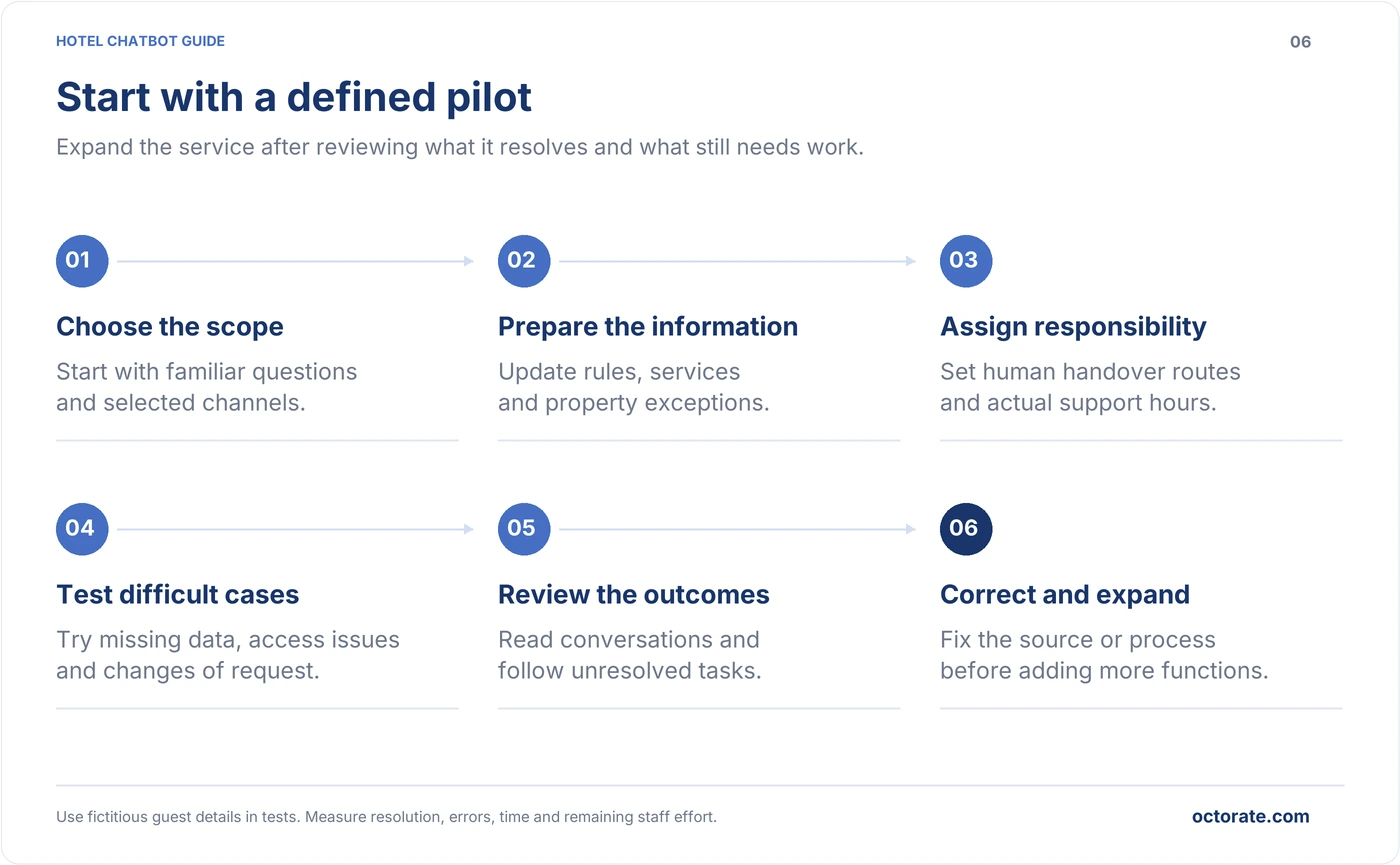
Start with a limited service that the team understands well. General property questions are usually easier to test than changes to bookings or access arrangements. Expand the scope when the results support it.
A pilot with clear responsibilities
Use fictitious guest details in test cases. Include ordinary questions and failure cases, such as missing booking data, a closed service or an unavailable integration. Test the languages guests actually use, including short messages and corrections.
Review the first live conversations with the team. Record the cause of each problem, whether it was an outdated rule, missing data, unclear wording or an incorrect action. Correct the source or workflow rather than simply rewriting the individual reply.
Keep a practical way to pause automatic handling of a topic or channel while an issue is fixed. Reception and property managers need to know when a request is theirs to handle.
AI transparency and guest data
For systems within its scope, the EU AI Act, Regulation (EU) 2024/1689, addresses direct interaction with AI in Article 50(1). Providers must ensure that users are informed they are interacting with AI unless this is obvious. The European Commission’s Article 50 guidance states that the provision applies from 2 August 2026 and that the notice must be clear at the first interaction.
A practical introduction identifies the assistant as AI and explains how to reach a human. Present that information where the conversation begins. Do not assume that an EU rule applies everywhere simply because guests use the same messaging platform.
For UK operations, the ICO’s data protection principles include data minimisation, accuracy, storage limitation and security. Apply the relevant privacy requirements to the information collected, the reason it is needed, retention and access. A question about breakfast hours does not require a passport copy.
Document the data shared with each supplier and who can review conversations. Limit access to booking details according to the job being done, and establish how corrections and deletion requests are handled. These arrangements belong in the operating process from the start.
OctoAgent as an example of a connected AI agent
OctoAgent uses data from an Octorate account, including bookings, rooms, property rules and services. The English product page describes support for WhatsApp, email, OTA messaging and phone, with human intervention when needed.
Requests requiring team action become tickets with a description, priority and deadline. The team can follow and close them. In the Learning section, proposed lessons from human replies are reviewed and approved before use.
This provides a concrete example of the distinction made earlier. Answering a question, consulting a booking and coordinating an intervention are connected parts of guest service, each with its own outcome to assess.
Explore Octorate with your team’s daily tasks
Try Octorate free for 14 days. Use your enquiry types, arrival process and handover requirements to discuss which OctoAgent functions fit your operation and their commercial scope.
Start your Octorate free trial
Frequently asked questions
- IBM, What is a chatbot?, updated 16 July 2026. Definitions of rule-based chatbots, AI chatbots and agents. Accessed 22 September 2026.
- Meta, WhatsApp Business Platform Pricing. Delivered template messages, free service replies, the rolling 24-hour window and utility message exemptions. Accessed 22 September 2026.
- European Commission, Transparency obligations under Article 50 of the AI Act, updated 24 July 2026. Direct AI interaction, first-interaction notice and application date. Accessed 22 September 2026.
- Information Commissioner’s Office, A guide to the data protection principles. UK GDPR principles. The ICO marks this guidance as under review following legislative changes. Accessed 22 September 2026.
- Octorate, English OctoAgent, PMS, Booking Engine, Self Check-in, Vacation Rental, Web Concierge, Unified Inbox, Mobile App, AI Integration and Free Trial pages linked above. Product functions and trial duration. Accessed 22 September 2026.